AI’S TIPPING POINT: ACT WITH PURPOSE OR FALL BEHIND
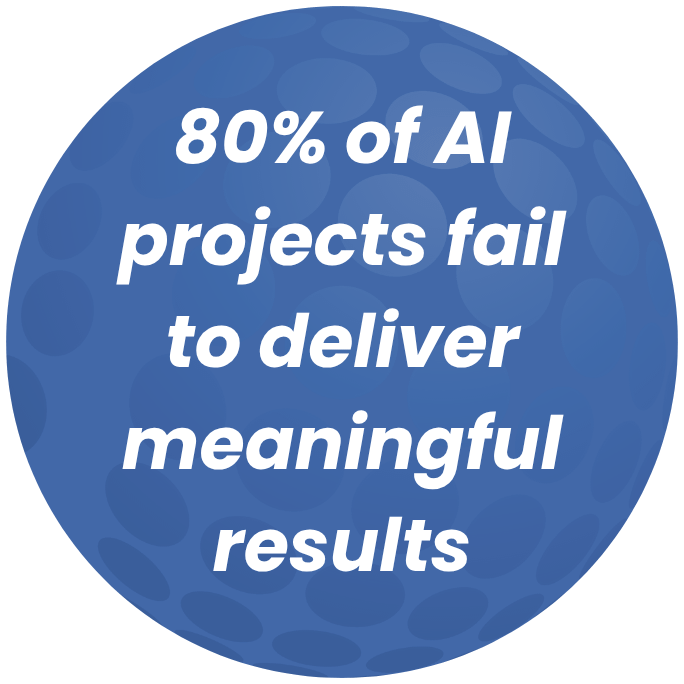
AI adoption is accelerating fast. IDC reports that usage jumped from 55% in 2023 to 75% in 2024 — but 80% of AI projects still fail to deliver meaningful results.
Experimentation is easy. Scaling with impact is hard.
The organizations succeeding today are transforming supply chains, customer service, and entire business models through AI built on solid foundations. The rest risk getting stuck in a “death by pilot” spiral, watching competitors compound their advantage.
The question for leadership isn’t whether to act — it’s whether you’ll act with purpose or keep improvising while others pull ahead.
ARTIFICIAL INTELLIGENCE IS A FORCE MULTIPLIER
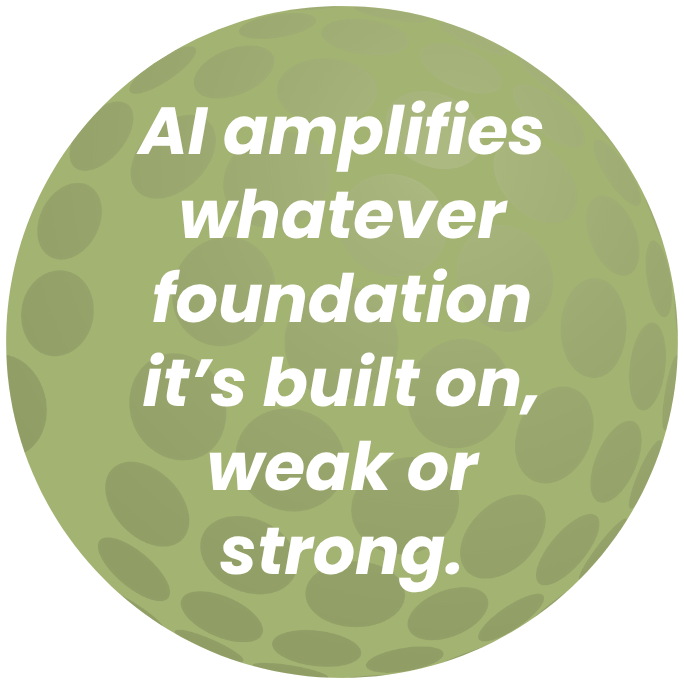
AI amplifies whatever foundation it’s built on, weak or strong. With a structured framework that connects strategy, governance, trusted data and an adaptable culture, AI becomes a growth engine. Without that foundation, it simply multiplies chaos, risk and confusion.
The organizations thriving with AI today aren’t the ones rushing pilots into production. They’re the ones investing in the framework and disciplines to make AI scalable, trustworthy and of real business value.
THE FRAMEWORK FOR TRUSTED, SCALABLE AI
Achieving success and scale with AI demands a disciplined framework that connects business strategy to implementation. The right approach blends governance, data architecture and cultural enablement through frameworks, accelerators and hands-on data engineering – turning AI from concept to measurable business value.
The AI framework rests on four core pillars:
- Strategic alignment to ensure AI directly supports business priorities and desired outcomes.
- Data readiness and governance to ensure high-quality data inputs for reliable, compliant outputs.
- Organizational change management to foster adoption and trust.
- Principled AI oversight to ensure ethical and responsible use of AI to mitigate risk and safeguard reputation.
Each pillar plays a distinct but connected role in turning AI ambition into sustainable enterprise value.
1. Strategic Alignment
Too many companies start with the question, “What can AI do for us?” The better question is, “What are we trying to achieve, and how can AI help us get there?”
Accenture’s research shows that companies with strong CEO sponsorship achieve 2.5x higher ROI. Those whose leaders deeply understand GenAI are 6x more likely to realize enterprise-level value.
By defining measurable targets, redesigning processes across silos, and leading from the top, winning companies are aligning AI with business priorities for transformative impact.
2. Data Readiness and Governance
AI is only as good as the data beneath it. Without a strong data foundation, organizations risk flawed insights, compliance gaps, and erosion of trust.
A data-ready framework connects modern infrastructure, integrated sources, structured information, and embedded governance. It ensures AI models have accurate, trusted data to learn from. Leaders who modernize their data estate and enforce governance at every layer build the reliability and transparency needed to scale AI confidently.
3. Organizational Change Management
Technology is the objective part – it works or it doesn’t. Adoption, on the other hand, is where outcomes have more nuance and subjectivity. Many organizations still spend 3x more of their GenAI budget on technology than on people, a gap that seriously undermines long-term value.
Employees across companies of every industry and size are worried that AI will replace them rather than empower them. That narrative must change. Adoption hinges on trust and perception. Leaders must lead the charge, helping employees see that AI is another tool in their toolbox, one that enhances their capability, not eliminates it. As NVIDIA CEO Jensen Huang put it, “You won’t lose your job to AI—you’ll lose your job to somebody who uses AI.”
AI success is directly proportional to the effort leaders invest into building trust, engagement and new ways of working. Too often, IT delivers an AI tool only to see customers, whether internal or external, ignore it. Without training, trust and executive sponsorship, employees will dismiss your AI rollout as another IT initiative that failed to take hold.
4. Principled AI Oversight
Principled AI oversight is the guardrail that makes AI safe to scale. It ensures that every deployment reflects principles of fairness, safety, privacy, inclusiveness, transparency, and accountability. Organizations that actively embrace these principles are 2.7x more likely to realize enterprise-level value.
Neglect them, and the consequences can be costly.
The message is clear: AI without standards and ethics creates risk. Conversely, AI with stewardship creates trust.
MEASURE EARLY, MEASURE OFTEN: A PRACTICE THAT STRENGTHENS EVERY PILLAR
While not a separate pillar, continuous measurement supports and strengthens every pillar of the AI framework. As with any analytics or technology initiative, waiting until the end to measure impact of your AI solutions is a recipe for sunk costs and low confidence. The organizations that win treat measurement as an integral part of the framework, tracking results early, measuring often, and adapting based on what they learn.
Leaders can apply the same discipline by embedding measurement into every stage of their AI initiatives, tracking outcomes across three dimensions:
- Internally to measure cycle time reductions, hours saved, process efficiencies.
- Externally to measure customer satisfaction, engagement, retention.
- Strategically to measure revenue growth, cost savings, speed of innovation, and competitive position.
By using measurement as a guiding principle, organizations can double down on high value use cases and retire the low-value ones quickly.
THE RISK OF IGNORING THE AI FRAMEWORK
Skipping the foundational framework leaves organizations caught in a cycle of pilots that never take off. Over time, each failure chips away at employee confidence, weakens customer trust, and erodes the credibility of AI as a strategic lever.
The risks are real:
- Brand damage. Ineffective, or worse, biased or inaccurate chatbots and flawed models frustrate customers, often amplifying unintended gender or racial inequities, and tarnishing reputation.
- Wasted investment. Pilot programs launched without a clear integration strategy consume resources without delivering measurable value and risk the ability to secure new budget.
- Compliance exposure. Gaps in oversight invite privacy breaches, and regulatory scrutiny. The result: a news headline waiting to happen.
- Cultural backlash. Employees lose faith in AI tools, making adoption continuously harder with each failed launch.
The longer organizations stay in pilot purgatory, the more trust erodes with customers, employees and the board.
THE VALUE OF WORKING WITH A TRUSTED PARTNER
AI cannot be left to IT alone. Business leaders will not (and should not) trust IT to design AI solutions in a vacuum. Nor should IT be expected to carry the full burden of delivery.
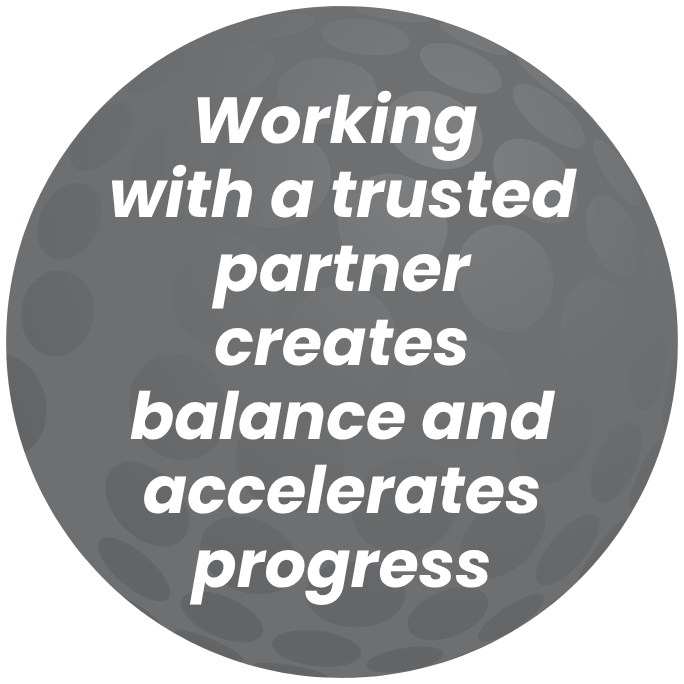
This is where working with a trusted partner creates balance and accelerates progress:
- Objectivity. An experienced third party helps to bridge the gap between business ambition and IT execution capabilities.
- Acceleration. Internal IT is often not equipped for large-scale implementation. A seasoned partner brings proven frameworks, accelerators, and cross-industry insights to shorten timelines and de-risk execution.
- Enablement. A non-biased voice is often best suited to train teams, embed governance, and drive adoption across the organization.
At Senturus, we help organizations move from pilot to profitable, performant and trusted AI. We combine strategy with execution, identifying high-value use cases, modernizing data estates on Azure, and delivering results that scale with confidence.
AI is a defining capability of modern enterprises. The leaders who succeed will be those who treat it as core strategy, prepare their data with discipline, and foster a culture ready to scale. The rest will watch competitors pull ahead.
AI is a force multiplier. The only question is whether it multiplies your strengths, or your risks.

